
How Does an Autoclave Work?

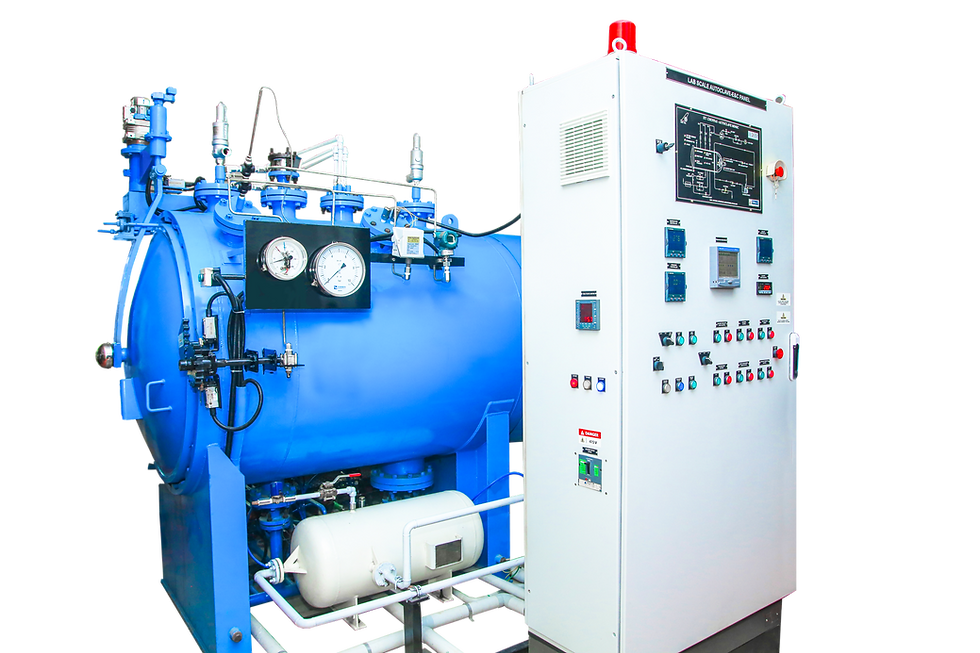
Process, Cycle & Key Components Explained
Autoclaves are among the most critical pieces of equipment in modern industry—used across aerospace, composites, pharmaceuticals, healthcare, and advanced manufacturing. While they may appear as simple pressure vessels, the reality is far more sophisticated.
Understanding the autoclave working principle, cycle phases, and core components is essential for engineers, procurement teams, and operators seeking precision, repeatability, and safety.
This guide breaks it down in a clear, technical, and practical way.
🔧 Autoclave Working Principle
At its core, an autoclave operates on a controlled combination of:
Heat
Pressure
Time
Controlled Atmosphere (Air/Steam/Vacuum)
The fundamental principle:
👉 Elevated pressure allows fluids (air/steam) to reach higher temperatures without boiling, enabling uniform heat transfer and effective processing.
In industrial autoclaves (like those used in aerospace composites):
Pressurized air or inert gas is used instead of steam
Vacuum systems remove trapped air and volatiles
Heat is applied through electric heaters or thermal oil systems
Precise PLC control ensures repeatable curing cycles
This ensures:✔ Void-free composite structures✔ Uniform curing✔ Structural integrity under critical applications
🔄 Autoclave Cycle Phases (Process Breakdown)
A complete autoclave cycle is not a single step—it is a multi-stage controlled process.
1️⃣ Purge Phase (Air Removal & Conditioning)
The cycle begins by preparing the internal environment.
Purpose:
Remove ambient air
Eliminate moisture and contaminants
Prepare for uniform heat transfer
How it works:
Vacuum pumps extract air from the chamber
In some systems, pressurization + venting cycles are repeated (purging loops)
Oxygen levels are minimized
👉 This phase is critical in aerospace applications, where even minor contamination can cause defects.
2️⃣ Heating & Pressurization (Ramp-Up Phase)
Once the chamber is conditioned:
Temperature is gradually increased (controlled ramp rate, e.g., 1–3°C/min)
Pressure is increased simultaneously
Why controlled ramping matters:
Prevents thermal stress
Avoids resin flow defects in composites
Ensures uniform material behavior
3️⃣ Exposure / Holding Phase (Core Processing Stage)
This is the most important phase of the autoclave cycle.
Parameters maintained:
Target temperature (e.g., 120°C to 250°C)
Pressure (e.g., 5–15 bar depending on application)
Vacuum (for composite curing)
What happens here:
Sterilization (medical) OR
Resin curing / bonding (industrial) OR
Material transformation under controlled conditions
👉 The duration is tightly controlled based on process requirements.
4️⃣ Cooling Phase (Controlled Down Cycle)
After exposure:
Heating is stopped
Cooling begins using:
Air circulation
Water cooling systems
Heat exchangers
Key requirement:👉 Controlled cooling rate to avoid:
Material distortion
Residual stress
Micro-cracking
5️⃣ Exhaust / Depressurization Phase
Final stage of the cycle:
Pressure is safely released
Vacuum is normalized
Chamber returns to atmospheric condition
Safety is critical here:
Rapid depressurization can damage components
Automated interlocks ensure safe operation
⚙️ Key Autoclave Components
An autoclave is a system, not just a vessel. Its performance depends on multiple integrated components:
🏗️ 1. Pressure Chamber
ASME-designed pressure vessel
Handles high pressure and temperature
Fabricated using carbon steel or stainless steel
Key design factors:
Thickness & stress calculations
Corrosion allowance
Fatigue resistance
🚪 2. Door System (Quick Lock Mechanism)
Hinged or bayonet-type doors
Designed for rapid and safe opening/closing
Includes:
Safety interlocks
Pressure locking systems
Sealing gaskets
🌡️ 3. Heating System
Electrical heaters / steam / thermal oil
Uniform heat distribution via forced circulation
Objective:👉 Maintain ±3°C temperature uniformity (critical in aerospace)
💨 4. Vacuum System
Vacuum pumps
Vacuum lines and ports
Function:
Remove entrapped air
Improve bonding and curing quality
Prevent void formation
🔁 5. Circulation System
High-performance blowers
Air ducting system
Purpose:
Ensure uniform temperature distribution
Eliminate hot/cold spots
🧠 6. Control System (PLC + HMI)
Fully automated control
Recipe-based cycle programming
Controls:
Temperature ramp rates
Pressure profiles
Vacuum levels
Safety interlocks
👉 This is the brain of the autoclave.
❄️ 7. Cooling System
Water-cooled heat exchangers
Air cooling mechanisms
Ensures:
Controlled cooldown
Process stability
🏭 Industrial vs Medical Autoclaves
While both operate on similar principles, their applications and complexity differ significantly:
Parameter | Industrial Autoclave | Medical Autoclave |
Purpose | Composite curing, bonding, processing | Sterilization |
Medium | Pressurized air / inert gas | Steam |
Temperature | Up to 250°C | Typically 121–134°C |
Pressure | High (5–15 bar+) | Moderate |
Complexity | High (vacuum, PLC, multi-zone control) | Relatively simple |
Cycle Control | Highly customized | Standard cycles |
👉 Industrial autoclaves demand precision engineering and advanced automation, especially in aerospace and defense applications.
🚀 Why Autoclave Process Matters in Modern Engineering
Autoclaves are not just equipment—they are quality enablers.
They ensure:✔ Structural integrity✔ Process repeatability✔ Compliance with global standards (ASME, aerospace specs)✔ Defect-free production
In industries like aerospace, composites, and advanced manufacturing, the autoclave is often the final step that determines product reliability.
🏁 Conclusion
Understanding how an autoclave works goes beyond knowing heat and pressure—it’s about mastering a controlled, multi-variable process involving:
Precisely engineered cycle phases
Integrated high-performance components
Advanced automation and safety systems
From purge to exhaust, every stage plays a vital role in achieving consistent, high-quality output.
📩 Looking for Industrial or Aerospace Autoclaves?
KRR Engineering delivers high-performance, ASME-compliant autoclaves designed for:
Aerospace composites
Industrial processing
Advanced manufacturing applications
🌐 Visit: www.krrautoclave.com📧 Email: bd@krr.co.in
👉 Share your RFQ and let’s engineer your next high-performance solution.


Comments